
Bitcoin (BTC) price
BTC/USDT · BRVX price feed
80,626.58 USDT
+5.36% last 30 days
Bitcoin changes hands at 80,626.58 USDT on BRVX, −1.94% across the last 24 hours. It is quoted through BTC/USDT, BRVX's synthetic BTC perp that never expires, with the widest leverage band on the platform, 5x to 150x, and an opening fee of 0.1%.
Bitcoin perpetual terms on BRVX
- Leverage
- 150x default 50x
- BTC fee per side
- 0.1% $1.00 per $1,000 of BTC
- BTC, 30 days
- 74,999.90 – 87,395.67
- BTC funding, long / short
- 0.0205% / 0.0171% charged every hour
- BTC daily swing
- 2.65% average of 30
- BTC quotes
- 24/7 like the Bitcoin network
BTC/USDT: 0.667% against 150x equals the margin; 2% at 50x.
Bitcoin daily range averaged 2.65% (30 sessions); 17 topped 2%; peak range 8.06%, Sep 22.
A $1,000 Bitcoin position is 0.0124 BTC at 80,626.58 USDT: opening it costs $1.00, closing $1.00, and holding it adds about $4.93 a day long or $4.11 short.
Bitcoin at 150x: 0.667% against you can lose the whole margin. Past swings are no forecast.
Sources: BRVX tariffs API; BTC/USDT daily candles.
About Bitcoin
A fixed-supply network
Bitcoin was described in a 2008 white paper by the pseudonymous Satoshi Nakamoto, and its first block was mined in January 2009. The protocol caps supply at 21 million coins. New BTC enters circulation as block rewards to miners, roughly every ten minutes, and more than 19.5 million have already been issued.
The halving cycle
Every 210,000 blocks, about four years, the block reward is cut in half. It fell from 50 BTC to 25 in 2012, to 12.5 in 2016, to 6.25 in 2020 and to 3.125 in April 2024. Past halvings were followed by large rallies and deep bear markets, but the sample is small and each cycle has had different drivers, so the pattern is history, not a rule.
What moves BTC today
Since US exchange-traded funds holding bitcoin were approved in January 2024, daily fund flows have become a closely watched signal. Global liquidity and Fed rate expectations matter, as do regulatory news and large transfers by long-dormant wallets. In derivatives markets, crowded positioning can turn a normal dip into a cascade of forced closes, which is why BTC can fall 10% in an hour; at a high multiplier that kind of flush can wipe out the whole deposit, a real risk to size for.
Mining and hash rate
Miners compete to add blocks using specialised ASIC machines, and the total computing power, the hash rate, has climbed to hundreds of exahashes per second. Difficulty adjusts every 2,016 blocks, about two weeks, to keep blocks near ten minutes. Each halving squeezes miner revenue, so less efficient operators sell coins or shut down, and miner selling is one of the flows analysts watch around those dates.
Bitcoin's boom-and-bust record
BTC first reached $1,000 in late 2013, crashed about 85% after the Mt. Gox collapse, climbed to almost $20,000 in December 2017, and fell back to near $3,200 a year later. It set a record around $69,000 in November 2021, dropped below $16,000 after FTX failed in 2022, and pushed past $100,000 in December 2024. Declines of 70–80% from a peak have happened in each major cycle so far.
Weekends and the CME gap
Crypto spot markets never close, but CME bitcoin futures stop trading over the weekend. When the Monday futures open differs from Friday's close, traders call the difference a CME gap, and some watch whether price returns to fill it. On BRVX the BTC/USDT feed runs continuously, so the weekend move is already in the chart.
Units, addresses and dormant coins
One bitcoin divides into 100 million satoshis, so a purchase of a few dollars is possible on-chain even at a six-figure price. Public blockchain data lets anyone track coin age: supply that has not moved for a year or more is often read as long-term holder conviction, and when very old coins wake up, markets sometimes treat it as a sign of potential selling. Around 1.1 million BTC are widely attributed to Satoshi and have never moved.
Bitcoin on BRVX
BTC/USDT tracks the bitcoin price; you hold no coins and no wallet key. BTC has the highest cap on BRVX at 150x, the app presets 50x by default, and funding differs by side: currently 0.0205% per hour for longs and 0.0171% for shorts.
Bitcoin price history
Bitcoin +4.46% in 30 sessions: 16 up, 13 down; top move +6.7% on Sep 22; 7d 80,393.57–84,348.46; 30d 74,999.90–87,395.67.
| Date | Open | High | Low | Close | Change |
|---|---|---|---|---|---|
| Oct 15, 2026 | 83,169.01 | 84,146.72 | 81,444.44 | 81,682.02 | −1.79% |
| Oct 14, 2026 | 81,850.01 | 84,168.00 | 81,057.32 | 83,169.01 | +1.61% |
| Oct 13, 2026 | 83,773.12 | 84,348.46 | 81,750.07 | 81,850.01 | −2.30% |
| Oct 12, 2026 | 82,988.36 | 84,199.00 | 82,804.66 | 83,773.12 | +0.95% |
| Oct 11, 2026 | 82,635.56 | 83,173.29 | 82,545.83 | 82,988.36 | +0.43% |
| Oct 10, 2026 | 82,510.01 | 83,517.95 | 82,285.72 | 82,635.56 | +1.08% |
| Oct 9, 2026 | 83,321.81 | 83,521.15 | 80,393.57 | 81,754.46 | −1.88% |
Prices from the BRVX feed, BTC/USDT. Last candle Oct 15, 2026 UTC.
How Bitcoin has traded: all-time high, all-time low, history
Bitcoin all-time high on BRVX: 125,666.77 USDT (Oct 6, 2025). Low: 58,337.01 USDT (Jun 27, 2026). Now 81,682.02, −35.00% off the top, 40.02% over the bottom. BTC/USDT history here starts Jan 2, 2025, 652 daily candles; older BTC trading is not counted.
- BTC peak
- 125,666.77 Oct 6, 2025
- BTC bottom
- 58,337.01 Jun 27, 2026
- From the peak
- −35.00% peak 125,666.77
- On BRVX since
- Jan 2, 2025 652 candles
- Best BTC day
- +8.41% Mar 4, 2025
- Worst BTC day
- −9.86% Mar 5, 2025
Bitcoin returns by period
| Period | BTC change |
|---|---|
| 7 days | −1.97% |
| 30 days | +4.46% |
| 90 days | +27.97% |
| Year to date | −8.37% |
| Full BTC history | −12.74% |
Bitcoin by month
| Month | BTC open | High | Low | Close | BTC change |
|---|---|---|---|---|---|
| Oct 2026 · to date | 83,664.25 | 87,220.00 | 80,393.57 | 81,682.02 | −2.37% |
| Sep 2026 | 77,682.01 | 87,395.67 | 74,999.90 | 83,663.66 | +7.70% |
| Aug 2026 | 63,884.01 | 81,478.75 | 62,275.01 | 77,682.01 | +21.60% |
| Jul 2026 | 58,742.01 | 66,956.15 | 58,510.00 | 64,780.03 | +10.28% |
| Jun 2026 | 73,923.85 | 74,274.00 | 58,337.01 | 60,260.21 | −18.48% |
| May 2026 | 75,833.12 | 82,283.40 | 72,561.68 | 73,510.00 | −3.06% |
| Apr 2026 | 66,722.36 | 79,254.86 | 66,053.53 | 76,500.01 | +14.65% |
| Mar 2026 | 65,846.06 | 75,982.50 | 63,120.41 | 67,427.77 | +2.40% |
| Feb 2026 | 84,229.99 | 84,254.63 | 60,081.74 | 67,356.35 | −20.03% |
| Jan 2026 | 88,445.33 | 97,160.81 | 81,186.39 | 83,233.55 | −5.89% |
| Dec 2025 | 90,834.27 | 94,036.04 | 85,167.34 | 89,146.69 | −1.86% |
| Nov 2025 | 108,350.42 | 111,033.00 | 83,547.19 | 90,566.56 | −16.41% |
How Bitcoin trades across the week
Bitcoin on BRVX, Sat–Sun: 1.64% average move vs 1.57% Mon–Fri (1.05×), about even.
| Day | Days | BTC avg | Avg size | Up |
|---|---|---|---|---|
| Monday | 93 | +0.18% | 0.83% | 58% |
| Tuesday | 93 | +0.13% | 1.86% | 49% |
| Wednesday | 93 | −0.15% | 1.76% | 47% |
| Thursday | 93 | +0.29% | 1.75% | 52% |
| Friday | 93 | +0.06% | 1.65% | 57% |
| Saturday | 93 | −0.35% | 1.90% | 42% |
| Sunday | 93 | −0.13% | 1.39% | 54% |
BTC at 150x: a 0.667% move the wrong way can lose the whole margin.
BTC/USDT daily candles from the BRVX feed, UTC, to Oct 15, 2026. Past moves do not predict future prices.
Bitcoin next to similar markets
Bitcoin's 150x cap sits between Dogecoin at 80x and Solana at 150x. Fees run from 0.05% per side at BNB to 0.1% at Bitcoin. In the last 24 hours Dogecoin led the group, −4.61%. Bitcoin's 150x cap is beaten by 0 of the 5 markets shown and topped by none of the rest; on fees, 5 of them undercut its 0.1% per side.
| Market | 24h | Gap vs BTC | Leverage cap |
|---|---|---|---|
| Bitcoin | −1.94% | — | 150x cap |
 Ethereum Ethereum | −3.46% | −1.52 pp | −50x vs BTC |
 Solana Solana | −2.43% | −0.49 pp | same as BTC |
 XRP XRP | −3.52% | −1.58 pp | −50x vs BTC |
 BNB BNB | −2.18% | −0.24 pp | −50x vs BTC |
 Dogecoin Dogecoin | −4.61% | −2.67 pp | −70x vs BTC |
Where BTC's cap is higher, a smaller move can lose the whole margin.
Before you open a Bitcoin position
Connect in seconds
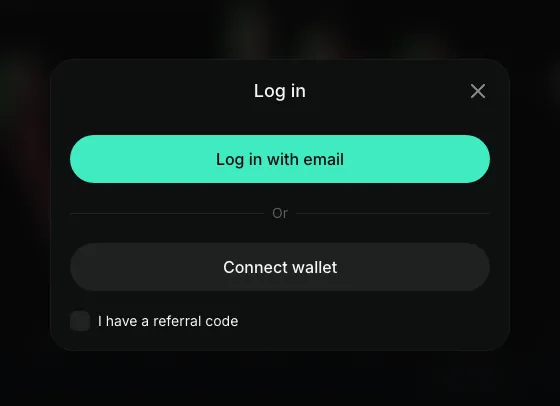
Log in with an email code or link a wallet through WalletConnect; if you already hold BTC, the wallet route is the quickest.
Use BTC itself as collateral
Accepted collateral: USDC, BTC, ETH, USDT, SOL or BNB. Posting BTC as margin on a BTC long doubles your exposure to the coin, so many traders prefer a stablecoin.
Choose a leverage preset
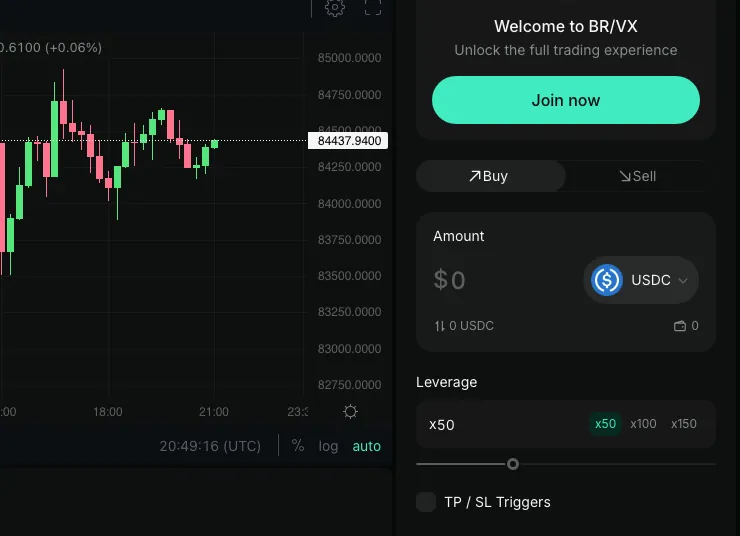
Open BTC/USDT, tap one of the x50, x100 or x150 presets or drag the slider down to 5x, choose a direction and fill in the TP and SL triggers.
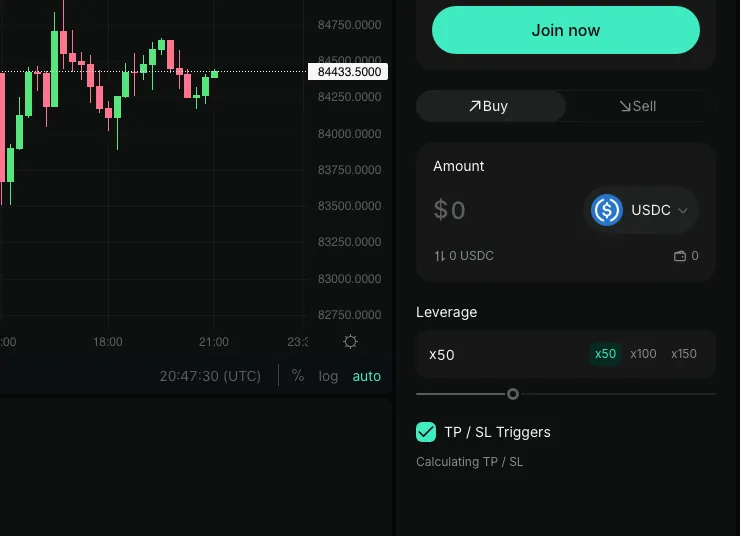


BTC at 150x: a 0.667% move the wrong way can lose the whole margin.
Long or short Bitcoin
Hypothetical BTC/USDT maths, ignoring fees and funding. Position = margin × leverage.
Run the scenario backwards and the trader is $60 down. At 20x, a 5% move against you is the full $100.
 BTC Bitcoin
 - Price move
- +3% $83,045.37
- Position P&L
- +$60.00
- On margin
- +60%
Hypothetical BTC figures. At 20x, 5% against you equals the margin; you can lose all of it.
Calculate your liquidation priceBitcoin price FAQ
Step-by-step long and short: how to trade Bitcoin.
What is the Bitcoin price today?
80,626.58 USDT on the BRVX BTC/USDT feed, −1.94% in 24 hours. This page updates every few minutes.
How many bitcoins will ever exist?
21 million, a limit written into the protocol. Over 19.5 million are already mined; the last fractions are expected around 2140.
What is the Bitcoin halving?
A cut in the block reward paid to miners every 210,000 blocks, about every four years. The most recent, in April 2024, reduced it to 3.125 BTC per block.
Why do BTC longs and shorts pay different funding?
On BRVX the rates differ by side: 0.0205% for longs and 0.0171% for shorts, charged every hour. Per the BRVX tariff data, longs and shorts are both charged.
Why is the fee on BTC higher than on stocks?
Bitcoin carries 0.1% on entry and 0.1% on exit, the top of the BRVX fee range; most stocks and commodities are cheaper per side.
How high does bitcoin leverage go?
Up to 150x, the highest on BRVX. At that cap a sub-1% bitcoin dip against the trade can erase the margin, so most of the risk sits in the leverage you choose.
What was bitcoin's all-time high?
BTC has set several records; it first passed $100,000 in December 2024. Check the BRVX chart for the current level against earlier peaks.
What happens to bitcoin after all 21 million are mined?
Miners would rely on transaction fees instead of block rewards. Issuance slows with each halving, so the final coins are expected around 2140.
Trade Bitcoin with up to 150x
Open appBitcoin never closes and can fall double digits in a day. High leverage makes that risk bigger. Not available to US persons.